Meet the TheyDo Agent
Run one journey discipline across every brand
Shared standard, distinct brand identity. Every brand on the same framework, every customer on the brand they recognize.













Each brand builds its own way of working
Every brand builds its own CX discipline, with its own methods, formats, and KPIs. The group can't compare across the portfolio, and best practices die at the brand boundary.


Shared standard.
Distinct brand identity
Multi-brand groups usually face trade-offs: enforce one standard top-down and flatten brand identity, or let each brand run its own way and lose the portfolio view. TheyDo lets you do both at once - the shared standard scales across brands while each one keeps its identity.
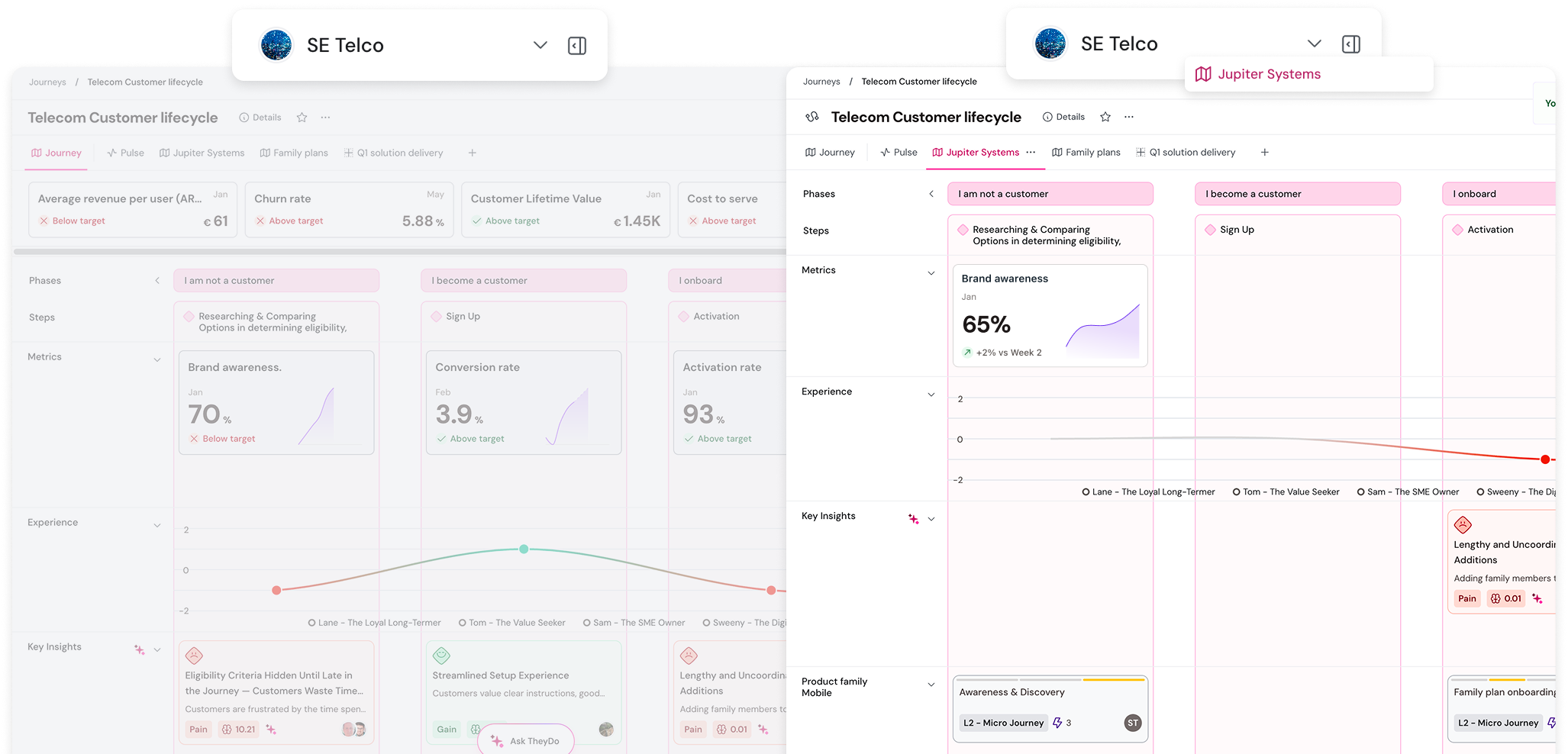
Shared standard
The group's framework, set once
Brand identity
Each brand keeps its customers, voice, and KPIs
Portfolio view
Performance compared across brands without flattening any of them
How businesses scale one standard across every brand
Set the shared framework
The group defines the journey framework. Every brand starts from it.
Brands already sharing one standard
Loading testimonials...
Ready to scale across every brand?
4,000+
hours saved
36%
efficiency lift
5x
time to value
90%
shorter time-to-decision
Questions buyers actually ask
What is a multi-brand journey program?
A multi-brand journey program is one shared customer journey framework, run across every brand in a portfolio. The group sets the master framework; each brand adapts it for its own customers, voice, and KPIs. Brand identity stays distinct; the structure stays shared, so the group can compare across the portfolio.
How do you scale a journey program across multiple brands?
TheyDo gives the group one shared journey framework. Each brand copies and adapts the master, keeping brand-specific touchpoints, language, and owners. The journey structure stays shared, so portfolio-wide comparison works without flattening brand identity.
Can TheyDo scale this across multiple product teams?
Yes. Collections give each team a scoped view of the ranked list relevant to their area. The evidence stays consistent; the view adapts to who's looking at it. Larger organizations run the same approach across multiple business units.
How is TheyDo different from rolling out a CX strategy via slide decks?
A slide deck is latent. Brands interpret it differently, build their own versions, and the group can't see the drift until the quarterly review. TheyDo makes the framework live. Every brand works within it, not beside it.
Can insights from one brand inform another?
Yes, when they sit at the same journey step. Insights from one brand surface where they apply across the portfolio. If the same friction shows up in another brand at the same step, the pattern is visible automatically, not through manual cross-brand digging.
How does a multi-brand journey program preserve brand identity?
The framework defines the structure (phases, steps, journey architecture). Each brand owns the content (touchpoints, customer voice, KPI targets). Brand teams keep autonomy over how the journey lands for their customer; the group keeps the ability to compare across the portfolio.
Who in the business runs a multi-brand journey program?
Usually a CX Program Manager or Center of Excellence owns the rollout. The Group CX Lead owns the framework. Brand CX Leads own brand execution. The VP Experience or CCO owns the portfolio outcome.