Meet the TheyDo Agent
Run one journey program across every market
Build the framework once, and every market works from it. Stop piecing the answer together from a stack of decks every quarter.
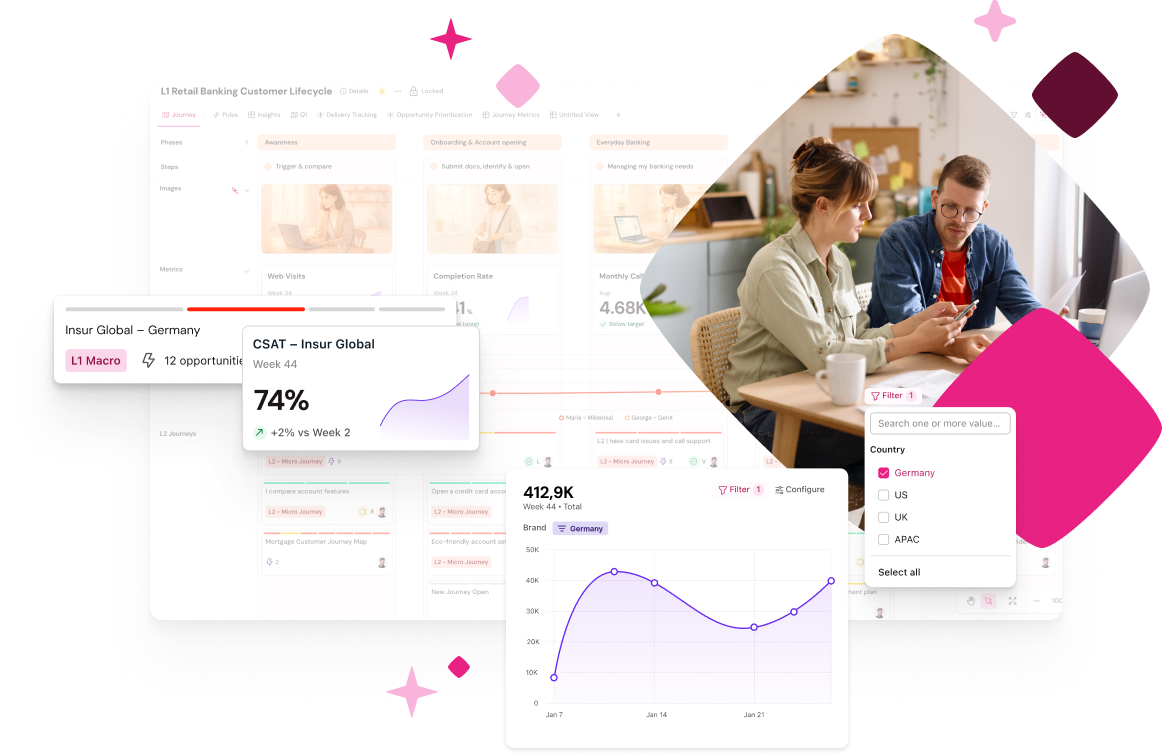












One framework, a different version in every market
The group built the standard. Then Germany mapped it in Miro, France in Confluence, Poland never picked it up. By the quarterly review, you have multiple versions of the framework and one person trying to line them up.


Shared standard.
Local execution
Multi-market groups usually face a losing trade: enforce one standard centrally and watch markets quietly ignore it, or let each market run its own way and lose any chance of comparing across markets. TheyDo lets both be true at once: consistency across markets and local relevance in each one.
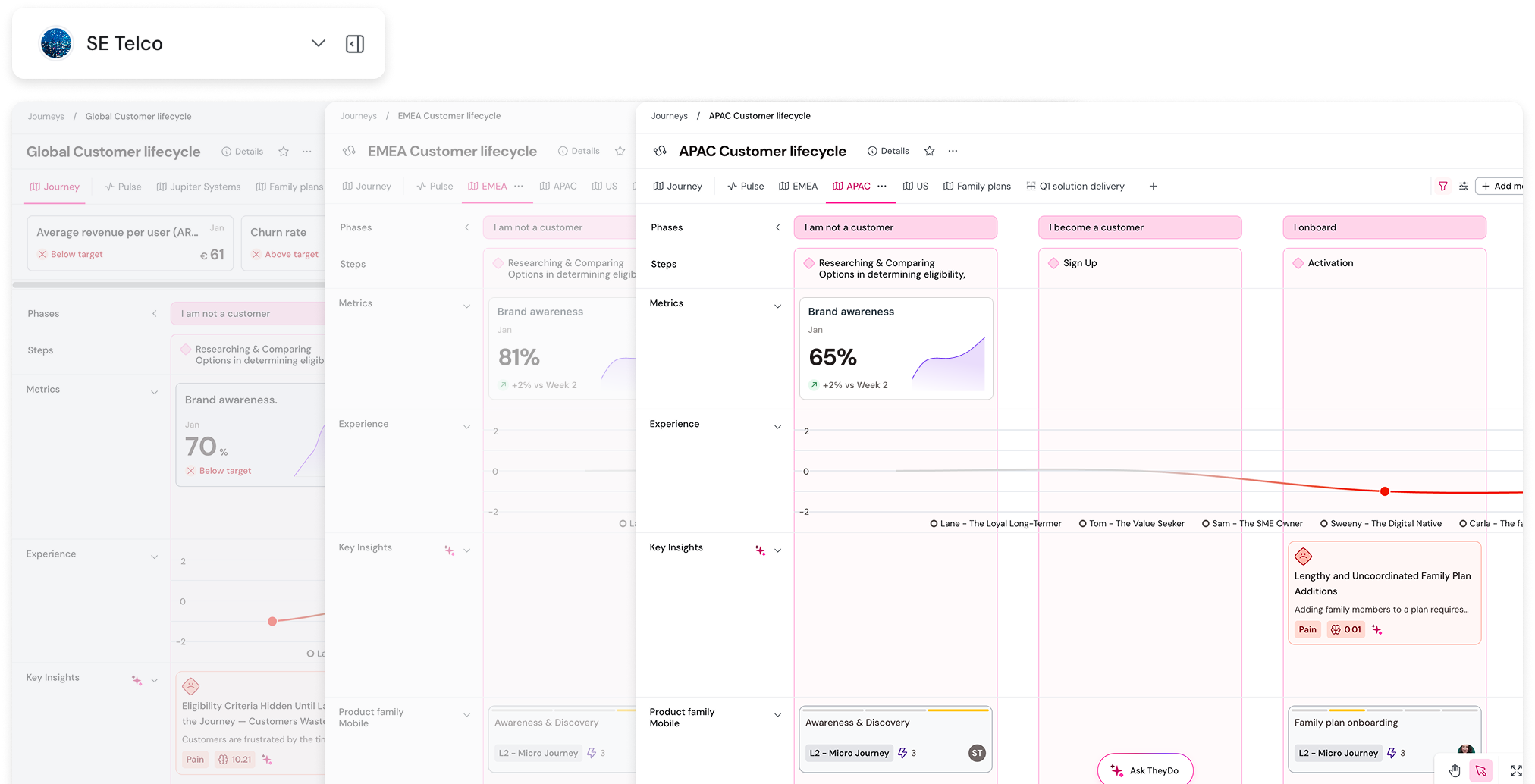
How businesses run one program across every market
Build the master framework
Set the journey framework once at the group level. Every market starts from the same base.
Customers already running multi-market programs
Loading testimonials...
Ready to run multi-market programs?
4,000+
hours saved
36%
efficiency lift
5x
time to value
90%
shorter time-to-decision
Questions buyers actually ask
What is a multi-market journey program?
A multi-market journey program is one shared customer journey framework, run across every country a business operates in. The group sets the master framework; each market copies and adapts it. Performance and insights surface at the same journey steps across every country, so the program runs as one, not many disconnected ones.
How do you run a multi-market journey program in TheyDo?
TheyDo gives the program one shared workspace. The group defines the master journey framework once. Each market copies and adapts it, keeping the same structure. Performance, insights, and opportunities appear at the same journey steps across every country, so cross-market comparison happens automatically, not as a quarterly exercise.
How fast can a multi-market program get running?
Most programs have the master framework live in TheyDo within weeks of kickoff. The first markets onboard in a quarter. Lyreco scaled from 4 to 80 practitioners across 25 countries this way.
Who in the business runs multi-market programs?
Usually a CX Program Manager or Center of Excellence owns the rollout. The Group CX Lead owns the framework. Market CX Leads own local execution. The VP Experience or CCO owns the outcome (NPS, revenue share, first-call resolution). TheyDo gives all of them the same view.
How is TheyDo different from rolling out a CX strategy via slide decks?
A slide deck is latent. Markets interpret it differently, build their own versions, and the group can't see the drift until the quarterly review. TheyDo makes the framework live. Every market works within it, not beside it.
How do markets work within the framework without losing local context?
Each market copies the master journey and localizes touchpoints, language, and step owners. The journey structure stays the same, so cross-market comparison still works. Local context lives where it should; the structure is shared.